Bypassing the Bidding War: The Quiet Revolution of Collector-Artist Partnerships
For decades, the auction house served as the art world's most theatrical institution—a room where provenance was announced, paddles were raised, and value was declared in the span of a few breathless minutes. Yet a discernible shift is underway among some of the market's most serious collectors. Increasingly, they are opting out of that spectacle entirely, choosing to build something far more durable: a direct, often deeply personal relationship with the artists themselves.
This is not merely a purchasing preference. It is, for many, a philosophical realignment—one that carries significant implications for galleries, auction houses, and the broader infrastructure through which contemporary art has long been bought and sold in the United States.
The Authenticity Imperative
At the center of this trend is a hunger for narrative that the traditional market has struggled to satisfy. Auction catalogs offer provenance and condition reports. Gallery white walls offer context, curated and carefully worded. But neither, collectors increasingly argue, offers the unmediated story of how and why a work came into being.
"There's a version of collecting that's essentially financial speculation dressed up in cultural clothing," says one New York-based advisor who works primarily with collectors in the $500,000-to-$5 million acquisition range. "What I'm seeing among my clients now is a genuine fatigue with that model. They want to know the artist. They want to understand what the work cost the person who made it—emotionally, intellectually, physically."
This desire for authenticity is not new to the art world, but its current intensity reflects broader cultural anxieties. In an era saturated with algorithmic curation and market-driven institutional programming, direct human connection has become a form of luxury in its own right.
How the Relationships Form
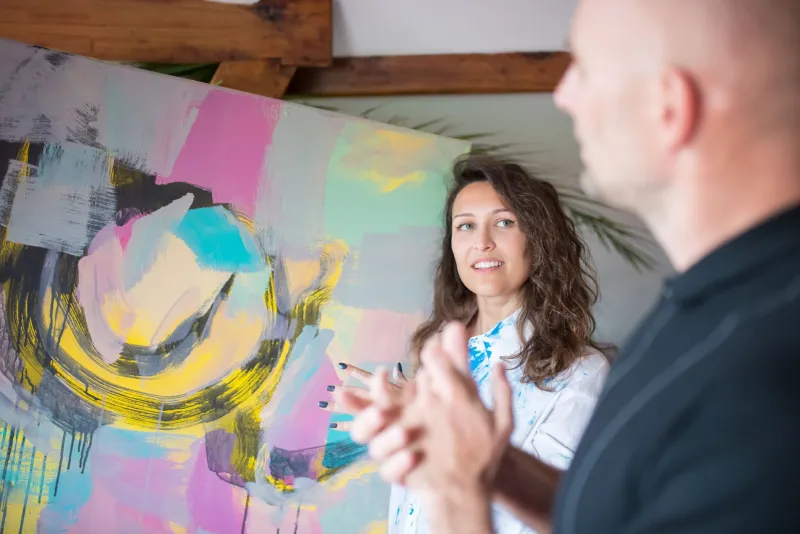
The pathways through which collectors and artists find one another outside formal market structures are varied and often informal. Studio visits—discussed at length elsewhere in this publication—play a central role, as do artist residencies, open studio events, and the social ecosystems surrounding alternative art spaces in cities like Los Angeles, Chicago, and New York. Academic institutions, too, have become unexpected matchmaking environments, with MFA thesis shows functioning as early-access markets for collectors willing to invest time before investing capital.
What distinguishes the most substantive collector-artist relationships, however, is their longitudinal character. Rather than a single transaction, these partnerships often unfold over years, with collectors acquiring work at multiple stages of an artist's career, offering financial support during lean periods, and in some cases funding specific projects or bodies of work.
One Los Angeles-based collector who has spent the past decade building a collection focused on emerging Black American artists describes the relationship with several artists in her collection as genuinely collaborative. "I've been present at the beginning of series that are now in museum collections," she explains. "That continuity—that sense of having been part of something—is something no auction room can manufacture."
The Dealer's Dilemma
For galleries, this trend presents a complex challenge. On one hand, many dealers actively encourage meaningful collector-artist relationships, understanding that emotionally invested collectors are more likely to become long-term stewards of an artist's legacy. On the other, the prospect of collectors circumventing gallery representation entirely—acquiring work directly from studios, negotiating privately, or funding projects outside the gallery's purview—threatens the economic foundation upon which dealer representation depends.
"There's a difference between a collector who visits the studio because they're excited about the work and a collector who visits the studio because they want to cut the gallery out of the transaction," notes one director at a mid-sized gallery in Chelsea. "The former is healthy. The latter is a real problem for everyone in the long run, including the artist."
The ethical dimensions here are genuinely contested. Artists, particularly those early in their careers, may be ill-equipped to manage the legal and financial complexities of direct sales, and the protective infrastructure that gallery representation provides—contractual terms, resale royalty agreements, institutional outreach—has real value that direct relationships do not automatically replicate.
Redistribution of Power
Nevertheless, the power dynamics are shifting in ways that are difficult to reverse. Social media has given artists direct access to collector audiences that previously required gallery mediation. Platforms ranging from Instagram to dedicated collector networks have compressed the distance between studio and living room, making the idea of a purely bilateral relationship between maker and buyer more technically feasible than at any prior moment in market history.
For artists with sufficient market traction, this creates genuine leverage. Several mid-career painters and sculptors have begun limiting gallery exclusivity in their contracts, reserving the right to sell a portion of their production directly—a practice that would have been commercially untenable a generation ago.
What Endures
It would be premature to declare the gallery model obsolete, or to suggest that auction houses are facing existential decline. The infrastructure they provide—authentication, market transparency, institutional relationships, and the legitimizing function of exhibition history—remains essential to the functioning of the art market at scale.
What is changing is the collector's sense of what acquisition is for. When a work is purchased through sustained relationship rather than competitive bidding, it carries a different kind of meaning—one rooted not in market validation but in genuine human exchange. Whether that meaning translates into long-term value, financial or otherwise, remains an open question. But for a growing number of collectors, it is the only question worth asking.